1
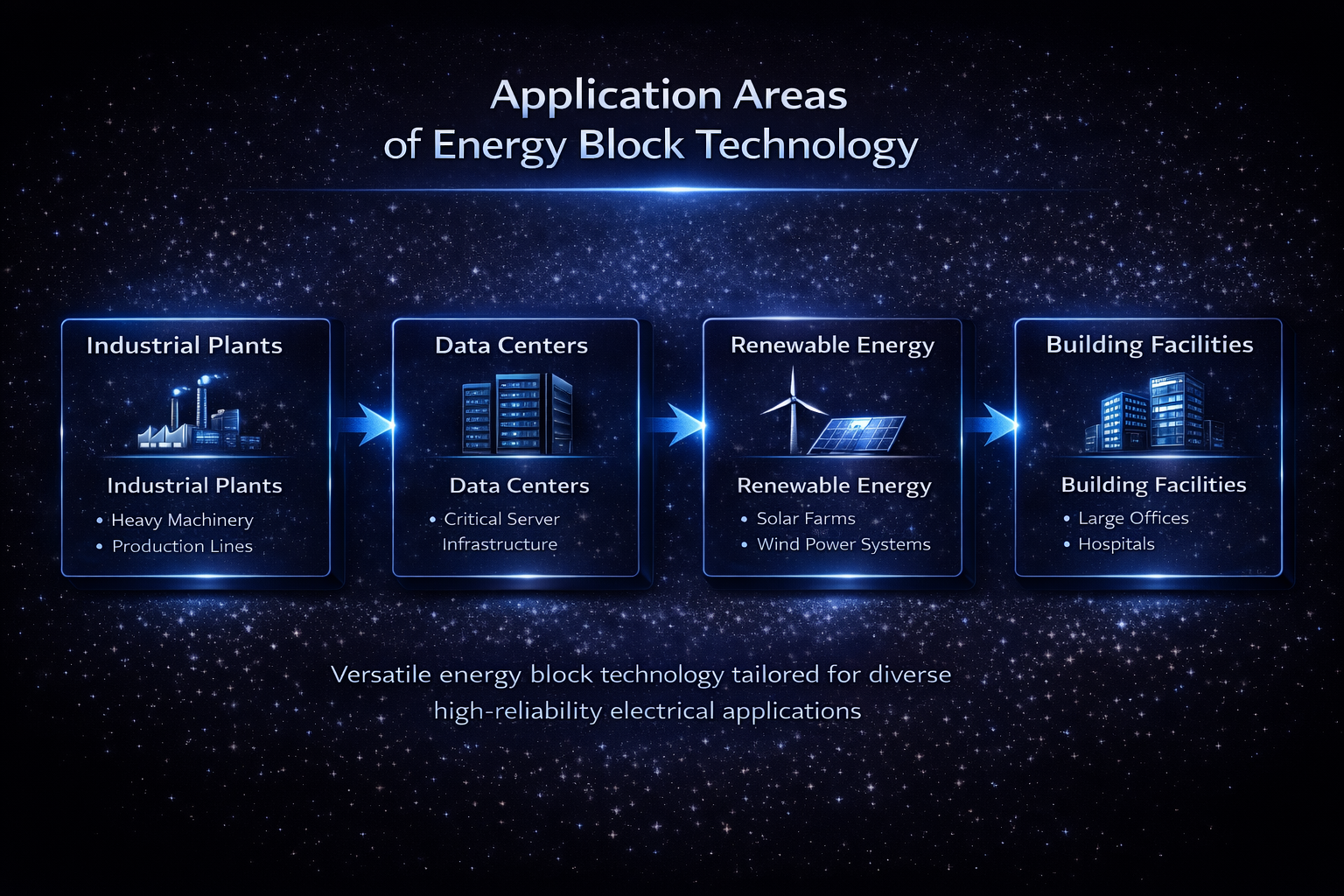
Industrial Power Facilities
Factories and production systems
Industrial power systems commonly experience harmonics, unbalanced currents, and
neutral-line currents due to non-linear loads, large motors, and inverter-driven equipment.
- Power supply systems for production equipment
- Rotating machinery such as motors, pumps, and compressors
- Inverter-based process equipment
- Stabilization of distribution panels and switchboards
By structurally mitigating power-quality degradation factors, Energy Block Technology
supports stable equipment operation and improved system reliability.
2
Building Power & Electrical Facilities
Commercial, public, and large-scale buildings
Building electrical systems typically include a wide mix of loads, where leakage
current and imbalance issues are continuously present.
- Building distribution systems and neutral conductor structures
- HVAC, elevator, and lighting power systems
- Data centers and IT infrastructure power environments
- Electrical safety structures for fire and electric-shock prevention
Energy Block Technology contributes to safety by structural stabilization rather than
relying solely on disconnection-based protection.
3
Mobility and Mobile Power Systems
Vehicles and transport platforms
Vehicles and mobile power systems are prone to unstable current environments due to
limited power architectures and high-density electrical and electronic components.
- Electrical and hybrid vehicle onboard power systems
- Auxiliary power supplies and battery systems for vehicles
- Mobile generators and charging systems
- Power environments in ships, rail systems, and special-purpose vehicles
In these applications, Energy Block Technology serves as a structural auxiliary
technology to enhance power stability and electrical safety.
4
Energy Storage & Distributed Power Systems
ESS, renewables, and microgrids
Distributed energy systems such as ESS, photovoltaic generation, and microgrids
face challenges related to power-flow variability and system instability.
- Power systems of energy storage systems (ESS)
- Interconnection points with solar and wind inverters
- Standalone and grid-connected microgrids
- Small-scale distributed power operation environments
Energy Block Technology stabilizes operating conditions by organizing abnormal current
components within these systems.
5
Electrical Safety & Preventive Systems
Safety-oriented applications
Beyond energy efficiency, Energy Block Technology can be applied as a structural
safety approach aimed at preventing electrical accidents.
- Reduction of electric-shock and leakage-current risks
- Mitigation of current components that may cause electrical fires
- Preventive safety structures with reduced reliance on protective-device operation
- Improved long-term operational stability and equipment reliability
This represents a preventive electrical-safety design approach that lowers accident
probability before protective devices are required to operate.