



Separation
Identifying abnormal components
Based on voltage–current correlation and waveform characteristics, abnormal components are distinguished from effective components and treated independently within the system.
|
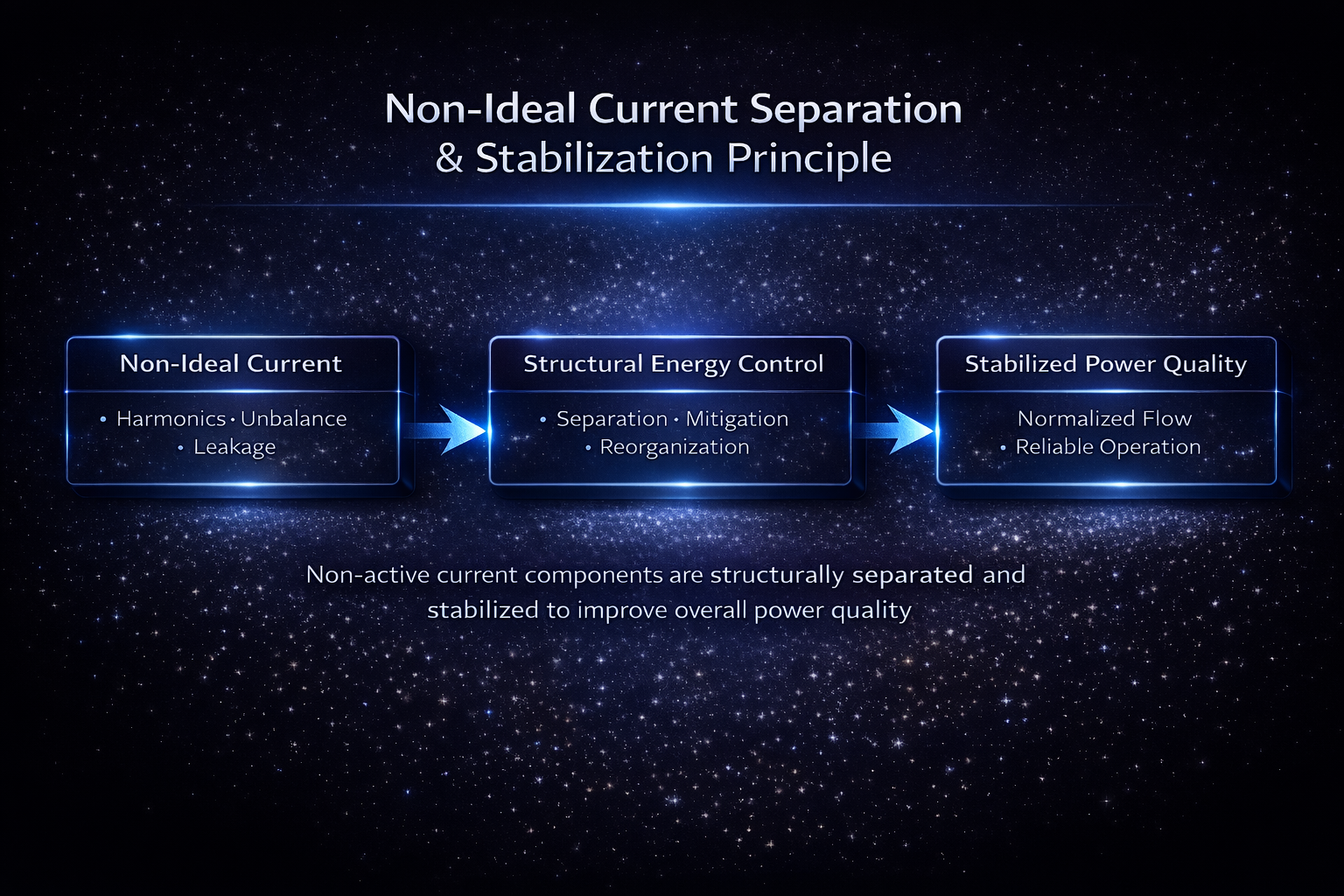
Principle of Abnormal Current Component Separation & StabilizationThis approach structurally organizes non-active current in the power system to normalize current flow, while simultaneously securing power quality and operational stability.
Abnormal current components may include harmonic currents, unbalanced currents,
phase distortion, and leakage-related components. These factors can contribute to
increased losses, heat generation, metering distortion, and reduced equipment stability.
SeparationIdentifying abnormal components
Based on voltage–current correlation and waveform characteristics, abnormal components are distinguished from effective components and treated independently within the system. Block Structuring / BlockingConfining the spread of abnormal components
Separated abnormal components are confined so they do not propagate across the overall network. The flow is organized by limiting them to a structured zone (Energy Block). StabilizationAligning current paths and phase relationships
Current paths and phase relationships become aligned, leading to reduced line-current fluctuation, normalized metering behavior, and stabilized power-quality conditions. Expected OutcomesSystem-level effects
|

