



Source-Level Separation
Isolation at the point of generation
Abnormal current components are separated at their points of generation, preventing them from being immediately superimposed onto the main power flow.
|
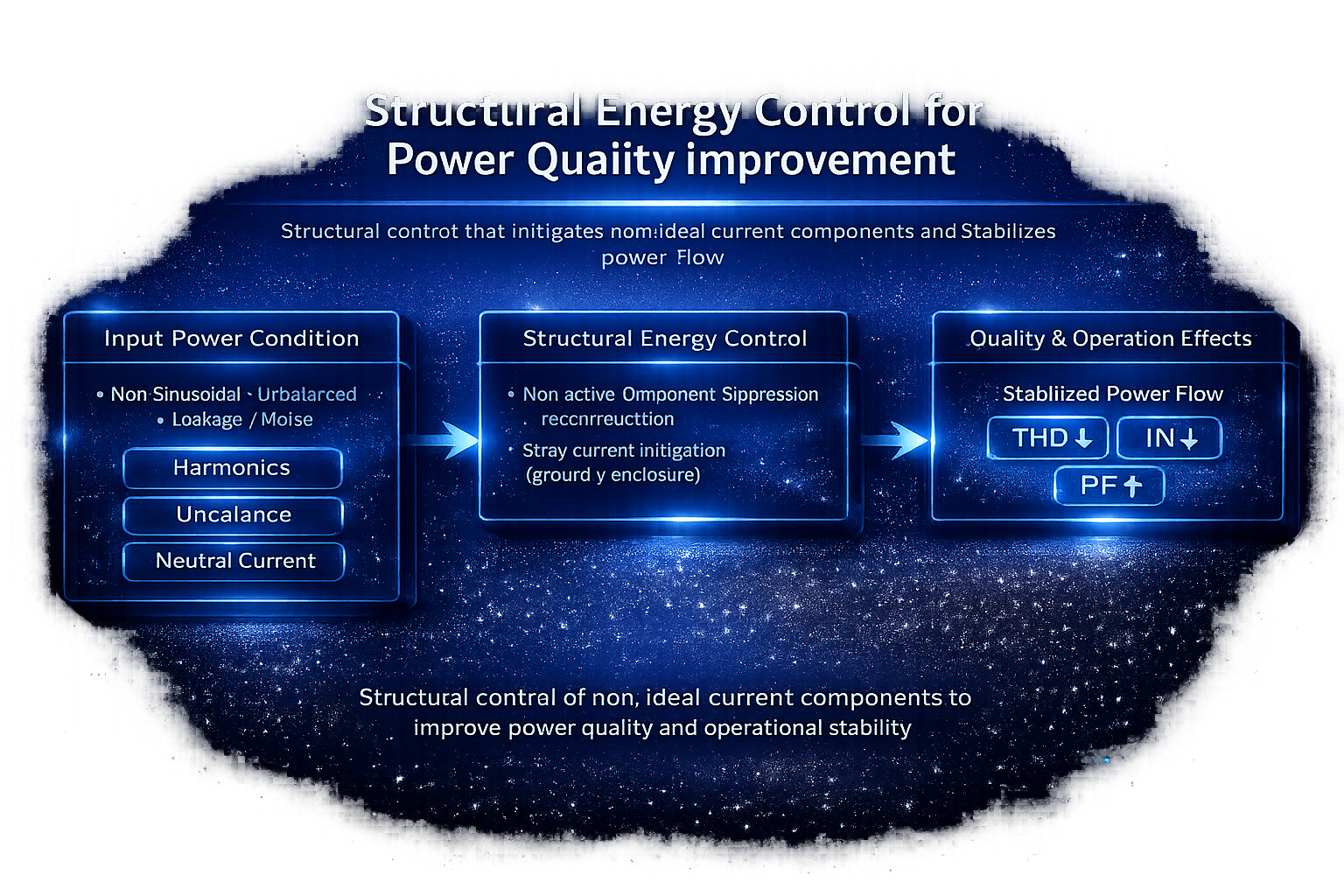
What Is Structural Energy Control for Power Quality Improvement?Structural Energy Control is a control concept that stabilizes power quality by reorganizing the structure of current flow itself, rather than generating energy, injecting additional power, or forcibly compensating reactive power.
In conventional power systems, abnormal components such as harmonics, unbalanced current,
neutral-line current, and leakage current tend to overlap and circulate depending on load
characteristics and system topology. These phenomena can lead to voltage distortion,
increased losses, equipment degradation, and malfunction.
Source-Level SeparationIsolation at the point of generation
Abnormal current components are separated at their points of generation, preventing them from being immediately superimposed onto the main power flow. Path StructuringPreventing diffusion and accumulation
Current paths are reorganized so that abnormal components do not diffuse or accumulate within the system, thereby limiting unnecessary circulation. Structural DecouplingSeparation from normal power flow
Abnormal current components are structurally decoupled and mitigated from the normal power flow, allowing the system to maintain stable operating conditions. Key Concept SummaryFoundational characteristics
Physical Meaning of Power Quality ImprovementSystem-level interpretation
These changes should not be interpreted as simple “energy savings,” but rather as a restoration of the power system to its original, structurally normal energy-delivery state. |

